How a Ruaraka Woman Turned KSh 5,000 Into a Thriving Mama Mboga Business
Are you thinking of starting a small business of selling vegetables and fruits? This article, which was compiled by the Haven Kenya team, will help you get started. The green grocery does not require as much money as a hotel or mitumba business. It is also a moving business where you will always be assured of customers, as it involves selling food. These are consumed daily by both the rich and the poor. In fact, it is even advisable for doctors to always eat green vegetables and fruits to stay healthy.
To begin this business, it is good to know the following:
- Where to buy vegetables at wholesale prices, then go and sell them in quantities that will give you enough profit.
- The transport used to move goods from the market to your kibandaski or shop. For example, a trader staying in Rongai uses more transport to travel with goods from Nairobi CBD than a trader residing in Umoja.
- The quantity you are able to sell before they go bad and rot. This will help you avoid making losses.
- Get a good supplier who will provide you with quality goods that customers love. For example, if you find one who sells you sweet mangoes or oranges, your buyers will always come back.
- Lastly, choose a good location for selling your goods. Examples include in front of residential buildings where people living around will come from their houses to buy from you, or along busy roads where women pass after work and pick up shopping when heading home.
Joyce Nyeri – Green grocery Trader from Ruaraka Narrates Her Business Journey. She Began with Only KSh 5,000
Venture into Business
After getting my second-born while living in Nairobi, I realized life is not easy. Bills started piling up. I had to buy Pampers for my newborn baby and also take care of my firstborn. I thought about what I could do to at least help my husband, who was a mechanic at Nairobi Kariokor.
Many business ideas came into my mind, like starting a daycare or a salon, but since I had little capital and also two babies to take care of, I decided to open a small kibandaski in front of the apartment where we were staying.
Building a Kibandaski Structure
I talked to the caretaker of my plot, who then communicated with the landlord. He agreed, but they said they would charge me KSh 2,000 to use the small space.
Everything was now okay. I called a carpenter who made me a structure to display what I was selling. He charged me only KSh 1,000.
Items I Bought at Muthurwa at Wholesale Price
The next day, I went to Muthurwa, as I was advised by a fellow mama mboga who was operating a similar business. She told me I should be at the marketplace by 5am to get the best and fresh goods.
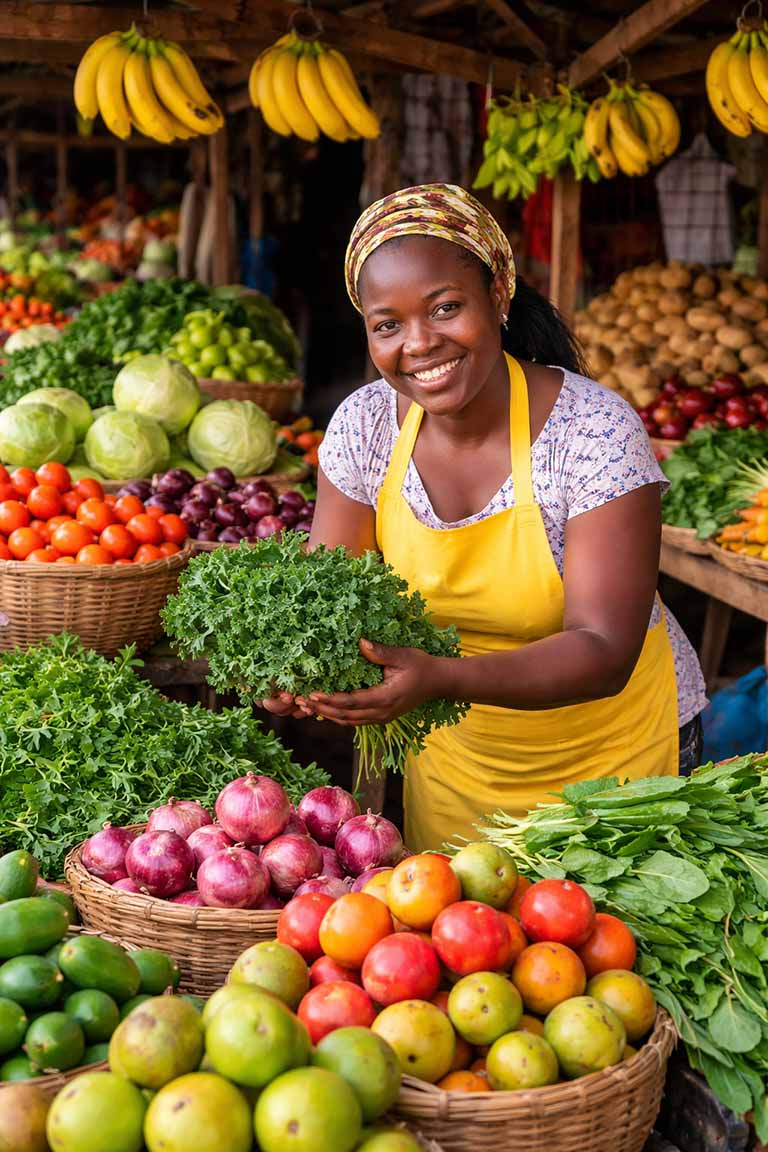
At the market, I picked the best vegetables that people like most: kales, terere, managu, spinach, sukuma wiki, and cabbage. I also bought onions, tomatoes, mangoes, and oranges. All these cost me KSh 1,500. I did not buy much since it was my first time.
I then packaged them and used a matatu, where I paid KSh 100 for luggage and another KSh 100 for my fare.
How I Attracted My Customers
On the first day of opening my mama mboga business, I was surprised to make a profit of KSh 700, and that really motivated me. People really liked me, and I became famous in the area because I was friendly to many. I also ensured that my vegetables and fruits were clean, which customers really loved.
Business Success
After 6 years in the business, I now thank God. I have made enough profit from the mama mboga business, and I now own a retail shop and an M-Pesa shop.
Her Message to Kenyans
Today, she is proud of how far she has come from such a small beginning.
“I started with KSh 5,000 only. What matters is not how much you have, but the decision to start,” she advised.
Her story is a reminder that even the smallest business can grow into something meaningful with patience and hard work.