How to Start Water Refilling Business in Kenya: Cost, Requirements, and Treatment Process
The water refilling business is one of the most profitable ventures to consider currently in Kenya. Water is a necessity for the human body, and it is consumed every day for the proper functioning of the body’s organs. Doctors and teachers usually advise people to use clean and treated water to prevent contracting diseases such as cholera, typhoid fever, and dysentery.
By setting up this business in a good location, you will be assured of customers who will buy in large quantities for shops and institutions, as well as residents living around the area who refill water regularly.
There are important things you need to know when planning to open this business, such as the amount of capital required, the equipment needed, and how the treatment process is done.
Cost and Requirements
1. Reverse Osmosis (RO) Machine
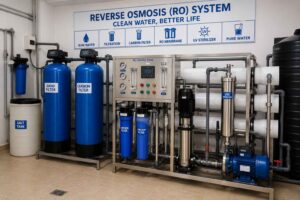
The main machine in this business is the Reverse Osmosis (RO) machine, which is used for water purification. They come in different sizes, and your preference will depend on many factors, such as:
The Location
In big cities like Nairobi, the demand is usually high, especially in populated areas such as Pipeline Estate or Zimmerman Estate. In such places, you need to go for a medium-standard setup. In this case, you will need a machine with a capacity of 250–500 LPH (Litres Per Hour). This can cost an estimated Ksh 300,000 to Ksh 600,000.
Demand
In areas with low demand or in small towns, use a small setup RO machine. You do not need a large and costly one. Go for a small kiosk setup with a capacity of 125–250 LPH. It costs between Ksh 150,000 and Ksh 300,000.
Target Buyers
When planning to set up a large commercial bottling plant that supplies retail shops or a depot where customers buy at wholesale prices, you should go for a 1000+ LPH automated purification line. This is expensive and costs from Ksh 1 million to Ksh 2 million.
2. Rent
A spacious room is required to set up your RO machine, tanks, and sales area. The room should be approximately the size of a one-bedroom house. In most places in Kenya, such spaces cost between Ksh 35,000 and Ksh 80,000 per month, depending on the location.
3. Interior Design
This includes proper partitioning of the room so that there are sections for the machine, tanks, bottle storage, and refilling.
Ensure there is proper lighting inside. Use bright LED lighting to give the room a clean and pristine look.
Keep all electrical switches and sockets safely positioned high on the walls, completely isolated from water supply lines and splashing risks.
Install powerful exhaust fans to prevent mold growth on the ceiling caused by high humidity from constant water handling. This can cost around Ksh 100,000.
4. Branding
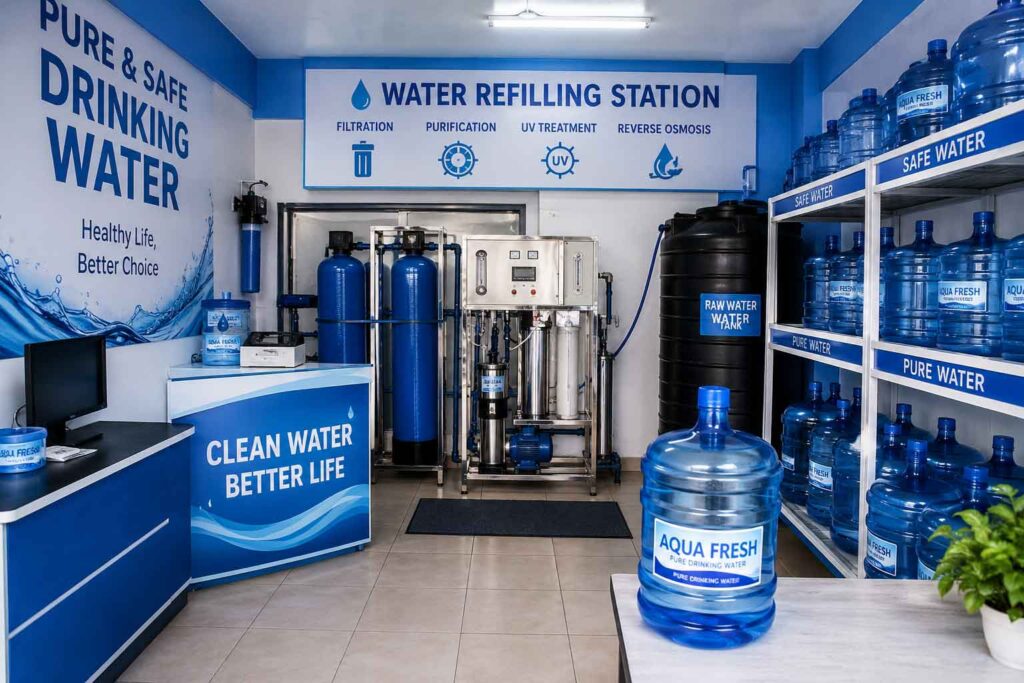
Choose a good name for your water refilling station, for example, Aqua Fresh. Use it to create custom wall coverings, signage, and bottle seal packaging. This can cost between Ksh 20,000 and Ksh 300,000.
5. Water Supply
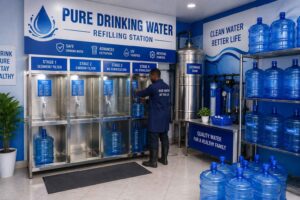
You need to have a constant supply of water that will go through the tanks. Most businesses use water supplied by the county council and pay monthly according to the amount used.
Legal Steps to Register a Water Vending Business
Register your business name through the eCitizen portal. It costs from Ksh 950 to Ksh 10,000, depending on the size of the business. You will then be provided with a Business Registration Certificate.
Apply for a County Government Business Permit. When applying, you must provide the Business Registration Certificate, business location, and KRA PIN. It costs from Ksh 5,000 to Ksh 50,000, depending on the county.
Visit the Public Health Office. They will inspect your premises for hygiene standards before issuing you a working license. These costs range from Ksh 10,000 to Ksh 50,000.
Public Health Medical Certificate
Every employee handling water requires a Food Handler’s Certificate. It costs approximately KSh 1,000 per person.
Register your operations with the Water Services Regulatory Board, which authorizes the legal operation of your business. This is free.
Visit the KEBS office to approve the labeling and packaging of your bottles. They will visit your premises, take raw water samples to their laboratory, and check whether the chemicals being used are safe. This may cost Ksh 20,000 or more. This is mandatory only if you seal and package branded bottles for supermarket shelves.
Register the business with KRA to submit yearly tax compliance.
What You Should Know About the Water Treatment Process
There are four main processes used when treating water. This process does not involve the use of chemicals.
1. Sedimentation
Water from the county council or borehole enters the tank and passes through cartridge filters to remove suspended particles such as sand, rust, silt, and physical dirt.
2. Activated Carbon Filtration
An activated carbon bed absorbs organic compounds, chlorine, and chemical gases. This stage is critical for removing bad odors and improving taste.
3. Purification
There are three membranes in this stage. If one fails, the water passes through another until it is fully filtered.
Water is pushed under high pressure through a semipermeable membrane. It rejects 99.9% of dissolved solids (TDS), heavy metals, fluorides, and microplastics.
4. Disinfection (Ultra-Violet (UV) Sterilization)
The water passes through a chamber exposed to UV light rays. This disrupts the DNA of any surviving bacteria, viruses, or parasites, rendering them completely harmless.
How to Run a Water Selling Business
To begin, you should know which water bottle sizes sell the most and ensure you have them in large quantities. For example, in Nairobi estates, the most popular bottles are the 5-litre and 10-litre bottles. Residents usually refill them at Ksh 50 and Ksh 100, respectively.
When demand increases and the business becomes more popular, introduce small 500ml bottles. These are bought by traders who resell them in shops or on the streets. A bottle costs around Ksh 35, then you package and sell them in dozens.